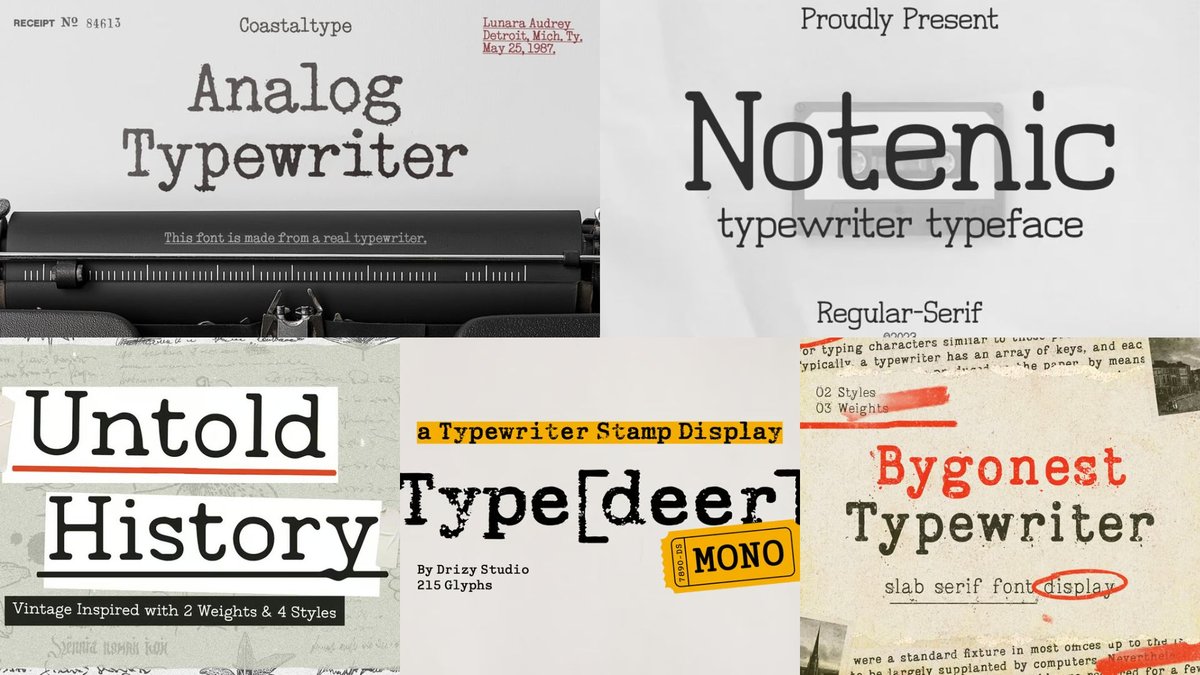
You know the look. That slightly worn, perfectly spaced, unmistakable imprint that instantly conjures images of earnest writers, clandestine documents, or the gritty realism of a bygone era. It's more than just a typeface; it's a feeling, a whisper from the past that speaks volumes in our digital age. The history and appeal of typewriter fonts are woven into the fabric of mechanical innovation, literary culture, and contemporary design, proving that some classics simply refuse to fade.
It's a testament to their unique character that, despite the infinite possibilities of modern typography, these fonts continue to be a favored choice for designers, writers, and artists seeking to infuse their work with authenticity, nostalgia, or a distinctive sense of purpose.
At a Glance
- Typewriter fonts originated from the mechanical constraints of early typewriters, necessitating monospaced characters.
- Pioneers like Christopher Latham Sholes introduced innovations like the QWERTY keyboard and established the foundation for these unique typefaces.
- Iconic fonts such as Pica and IBM's Courier gained prominence, shaping the visual language of business, literature, and coding.
- Digitization has preserved their vintage charm, making them versatile tools for modern design across branding, pop culture, and personal expression.
- Their appeal stems from a powerful blend of nostalgia, practical utility (especially in coding), and an aesthetic that values "imperfection" as a mark of human character.
- Beyond digital screens, typewriter fonts manifest in body art and celebrate the craftsmanship of vintage machines, fostering a tangible connection to history and creativity.
The Click, Clack, and the Birth of a Typographic Style
Before the sleek glow of a screen, there was the satisfying thwack of a type bar hitting an inked ribbon, leaving its mark on paper. This physical act birthed a distinct aesthetic, one governed by the mechanical realities of early typewriters.
The Machine That Started It All
The story of typewriter fonts truly begins in the 1860s with Christopher Latham Sholes, the inventor of the first commercially successful typewriter – the Sholes and Glidden typewriter. This groundbreaking machine didn't just introduce the now-ubiquitous QWERTY keyboard layout; it laid the foundation for an entirely new typographic style.
Crucially, early typewriters were inherently mechanical. Each key strike activated a type bar that moved to a fixed position to print its character. For this system to work reliably and economically, every character – whether a wide 'W' or a narrow 'I' – had to occupy precisely the same horizontal space. This necessity gave rise to monospaced fonts, a defining characteristic of all true typewriter typefaces. It was a constraint born of engineering, but one that would inadvertently become a hallmark of their aesthetic.
Early fonts were designed for sheer utility. They needed to be legible, robust enough to withstand repeated striking, and consistent in their output. Aesthetics took a back seat to function, yet this very focus on function forged a beauty of its own.
Iconic Typefaces Emerge from the Metal
As typewriters evolved and manufacturers sought to distinguish their models, so did their typefaces. While still bound by the monospaced principle, subtle variations began to emerge, each imparting a distinct personality.
One of the earliest and most recognizable styles was Pica. This was a robust, legible, and utilitarian font, becoming the workhorse for businesses, government documents, and factual reporting. It was the font of record, unpretentious and direct, designed to be read, not admired.
Then came Courier, arguably the most famous typewriter font of all time. Designed by Howard Kettler for IBM, Courier wasn't just a font; it was a revolution. Initially created for IBM's electric typewriters, it found its home in accounting, coding, and eventually, the literary world. Its rigid, unvarnished appearance was unintentional at first, but it struck a chord. In the late 20th century, Courier became inextricably linked with postmodern literature, its stark simplicity and precise rhythm complementing themes of alienation, existential dread, and the cold, hard truths explored by authors like Cormac McCarthy and Don DeLillo. It gave their words a visual cadence, a raw, almost unedited quality that pulled readers deeper into the narrative.
Beyond these utilitarian giants, manufacturers also experimented with script typefaces. These were often imperfect imitations of handwriting, designed to add a personal touch or a hint of formality to correspondence. Though often less common, they showcased the desire to push the boundaries of what a mechanical machine could convey, adding a layer of charming imperfection.
From Pressed Ink to Pixel Perfect: The Digital Evolution
The advent of personal computers and desktop publishing in the late 20th century could have spelled the end for typewriter fonts. After all, suddenly designers had proportional fonts, kerning, and an unprecedented level of typographic control. But instead of fading into obscurity, typewriter fonts experienced a remarkable digital renaissance.
Designers, recognizing their inherent charm and powerful evocative qualities, meticulously digitized these typefaces. This process involved not just scanning, but careful recreation, often preserving the subtle irregularities and ink bleeds that gave the original metal-stamped characters their unique soul. Digital technology allowed these fonts to shed their mechanical limitations while retaining their core aesthetic. No longer bound by the physical constraints of a type bar, they could be scaled, colored, and manipulated with ease, making them more versatile than ever.
It's a fascinating paradox: the digital world, built on perfection and precise algorithms, embraced the inherent "imperfection" of a technology born from springs and levers. This transformation ensures that the vintage charm of typewriter fonts isn't just a memory, but a living, evolving part of our contemporary visual language.
More Than Just Retro: Unpacking the Enduring Appeal
The lasting popularity of typewriter fonts goes far beyond simple nostalgia. While that's undoubtedly a powerful draw, their appeal is multifaceted, touching on practicality, aesthetic versatility, and even personal expression.
Nostalgia: A Tangible Link to the Past
In an age of endless digital fonts, the limitations of the typewriter fostered a different kind of focus, a deeper engagement with words. Each stroke was deliberate, a physical commitment to the page. Typewriter fonts carry that ghost of deliberate creation, reminding us of the writers who labored over these machines, the ideas they produced, and the historical documents they birthed.
They offer a tactile connection to the past, a sensory experience that grounds creativity in something real, enduring, and profoundly human. Seeing text in a typewriter font can evoke memories of old letters, classic novels, or even just the quiet hum of a distant office, creating an instant emotional resonance that few other font styles can match.
The Unsung Hero of Code: Practicality in Monospace
While their vintage appeal is undeniable, typewriter fonts have a deeply practical side that has kept them relevant in one of the most technical fields imaginable: coding. Their monospaced nature, once a mechanical necessity, is now a prized feature for programmers.
In coding, every character counts, and precise alignment is crucial for readability and debugging. Monospaced fonts ensure that columns line up perfectly, making it easy to spot syntax errors, trace logical flows, and distinguish between similar-looking characters like 'l' (lowercase L), '1' (numeral one), and 'I' (uppercase I). This inherent structure makes typewriter fonts a go-to choice for terminal windows, integrated development environments (IDEs), and any context where clear, unambiguous character alignment is paramount.
Aesthetic Versatility: A Tool for Every Story
The unique look of typewriter fonts makes them incredibly versatile for designers. They can instantly convey a range of moods and messages, from historical authenticity to rebellious grit.
- Branding & Identity: Brands seeking a vintage, artisanal, or authentic feel often turn to typewriter fonts. They can lend an air of trustworthiness and history to a logo or website, suggesting a legacy of craftsmanship. Think of how the raw, almost stencil-like quality of a typewriter font can give an immediate sense of purpose and no-nonsense communication, much like the famous "I love NY" logo's blocky, direct typeface.
- Pop Culture: Typewriter fonts are ubiquitous in pop culture, perfectly capturing specific eras or moods. They appear on movie posters, album covers, and book titles, instantly setting a scene. The "Stranger Things" title, with its distinctly retro, almost film-reel-like font, evokes the 1980s without needing a single additional graphic element. They're excellent for evoking period pieces, crime dramas, or anything that requires a sense of documentation or a handcrafted touch.
- Literature: Beyond the examples of McCarthy and DeLillo, typewriter fonts can profoundly impact the reading experience itself. In books like Mark Z. Danielewski's "House of Leaves," different fonts are used to represent distinct narrative voices or layers of text, creating a disorienting, immersive, and unforgettable journey for the reader. The rigid, unadorned quality can signify a primary source, a document, or a direct, unfiltered thought process.
Beyond the Screen: Typewriter Fonts as Self-Expression
The appeal extends even into personal expression, finding a unique home in body art. Typewriter font tattoos offer a distinct form of self-expression, carrying a sense of history and character. The slightly irregular, often subtly "faded" or "ink-blotted" appearance of these fonts on skin adds to their charm, making each word or phrase feel more authentic, more deliberate, and more intimately connected to a personal story. They stand apart from the crisp perfection of most modern typefaces, embodying a choice that values character over flawless execution.
The Beauty in the "Imperfection": Character Markers, Not Flaws
One of the most profound aspects of typewriter fonts is how they celebrate what, in other contexts, might be considered flaws. The subtle variations in stroke weight, the slight ink bleed around the edges, the occasional uneven pressure – these aren't errors. They are character markers.
These imperfections are precisely what give typewriter fonts their warmth and soul. They are traces of the mechanical process, reminders of the human hand that operated the machine. A perfectly rendered, mathematically precise digital font, while beautiful in its own right, can sometimes feel sterile. Typewriter fonts, by contrast, feel lived-in, authentic, and organic. They whisper stories of their origin, linking directly to the craftsmanship of the machine and the human involvement in its operation.
Replicating this nuanced imperfection digitally is a significant challenge for typographers. It requires careful design to introduce subtle randomization and texture without making the font illegible or messy. This is where tools designed to emulate that authentic vintage feel truly shine. For designers looking to infuse their work with that genuine, slightly imperfect charm without painstaking manual effort, a typewriter font generator can be an invaluable asset, allowing them to create text that feels like it’s just emerged from a classic Remington or an old Olivetti.
Curating a Legacy: The Typewriter as a Work of Art
The enduring appeal of typewriter fonts is inextricably linked to the physical machines that gave them life. Vintage typewriters themselves are considered testaments to craftsmanship, intricate marvels of gears, levers, and precisely engineered typefaces. Each component, from the spring-loaded keys to the perfectly aligned type bars, represents a pinnacle of mechanical ingenuity.
Restoring these machines isn't merely a hobby; it's an act of preserving a piece of history. Enthusiasts carefully clean, repair, and reactivate these mechanical wonders, understanding that they are not just tools, but artifacts. The very act of typing on a restored machine, feeling the resistance of the keys and hearing the satisfying ding of the carriage return, is a sensory journey back in time. It deepens the appreciation for the fonts they produced, recognizing that their irregularities and slight variations are not defects, but the authentic signatures of a technology that valued precision within its mechanical limits.
Choosing Your Type: Navigating Digital Typewriter Fonts
With countless digital versions of typewriter fonts available today, selecting the right one for your project can be a nuanced decision. It's not just about picking "a typewriter font"; it's about understanding the subtle differences and knowing when to deploy their unique power.
What to Look For in a Digital Typewriter Font
When you're browsing for a digital typewriter font, consider these characteristics to ensure it fits your vision:
- Monospaced Nature: This is fundamental. Ensure the font maintains strict monospacing for authenticity and functional applications like coding.
- Variety of "Imperfections": Do you want a clean, crisp typewriter look (like a freshly serviced machine) or something more distressed, with simulated ink bleeds, smudges, and uneven baselines? Many modern digital typewriter fonts offer multiple versions or OpenType features to introduce these intentional "flaws" realistically.
- Font Weights and Styles: Some typewriter fonts offer only a single weight, while others might provide bold, italic, or even light options, expanding their versatility.
- Legibility at Different Sizes: While charming, some distressed typewriter fonts can become difficult to read at very small sizes. Always test your chosen font in the context of your project.
- OpenType Features: Look for fonts that incorporate ligatures or alternate characters. These can help introduce subtle variations that mimic the "randomness" of a real typewriter, where not every character strikes perfectly identically.
When to Reach for a Typewriter Font (and When to Pause)
Knowing when to use a typewriter font is as important as knowing which one to pick.
Use a typewriter font when you want to:
- Evoke a sense of nostalgia, vintage, or retro aesthetics.
- Convey authenticity, history, or a handcrafted feel.
- Suggest documentation, official records, or personal correspondence.
- Create a raw, unpolished, or understated look.
- Design for coding, command-line interfaces, or technical documentation where monospacing is key.
- Add a distinct visual rhythm or texture to a design.
Pause (or reconsider) a typewriter font when you need: - Sleek modernity or high-tech sophistication.
- Maximum readability for very long, dense blocks of text in a formal setting (proportional fonts are generally more efficient for sustained reading).
- A corporate, polished, or overly refined aesthetic, unless the intentional contrast is part of a deliberate design statement.
- A delicate, elegant, or whimsical feel, which is usually outside their wheelhouse.
Beyond the Keyboard: The Future of Typewriter Typography
The journey of typewriter fonts—from mechanical necessity to digital artistry—is far from over. Their enduring presence in our visual landscape speaks volumes about the power of an authentic aesthetic. They remind us that sometimes, limitations can foster unique beauty, and that the echoes of past technologies can continue to inspire future designs.
New digital tools will undoubtedly continue to innovate on this centuries-old concept, offering more sophisticated ways to simulate the subtle nuances of ink on paper, the slight shift of the platen, and the charming irregularities that make these fonts so special. The conversation between past technology and future design will continue to evolve, ensuring that the distinctive voice of the typewriter font remains a cherished part of our creative toolkit.
So, the next time you encounter a typewriter font, pause for a moment. Appreciate its unique heritage, its practical genius, and its remarkable ability to connect us to a time when every character was a deliberate, physical act. It’s a profound connection to history, human creativity, and the simple elegance of a focused, deliberate mark on the page, whether digital or physical. Go ahead, experiment with their charm in your next project, and let their unique character speak for itself.